
How to Check for a Warrant in Pennville
Pennville's official pages do not provide a warrant search or name a local court. Start with the paper notice, citation, or known case and identify its issuing court. For Jay Circuit or Superior Court, MyCase is the public search aid. Portland City Court should be used only when that court appears on the citation. Confirm every result with the maintaining office.
- Review the notice for a court, case number, citation number, party name, and hearing date.
- Search Indiana MyCase for a public Jay Circuit or Superior case.
- Call the Jay Clerk at 260-726-4951 or the issuing court to verify the latest event.
- Call the Jay County Sheriff at 260-726-8188 or Security Center at 260-726-7541 for enforcement routing.
- Ask the court or an attorney about appearance, bond, recall, and proof before acting.
Pennville's Town-Hall-Only Public Route
The official Pennville town site lists 105 N Washington Street, Pennville, Indiana 47369. Its contact page gives PO Box 227 and 260-731-2801. The listed public hours are Monday from 9 a.m. to 1 p.m., Wednesday from 1:30 p.m. to 5:30 p.m., and Friday from 9 a.m. to 1 p.m.
The official Pennville town home is also the source for this view of the town's public entry point.
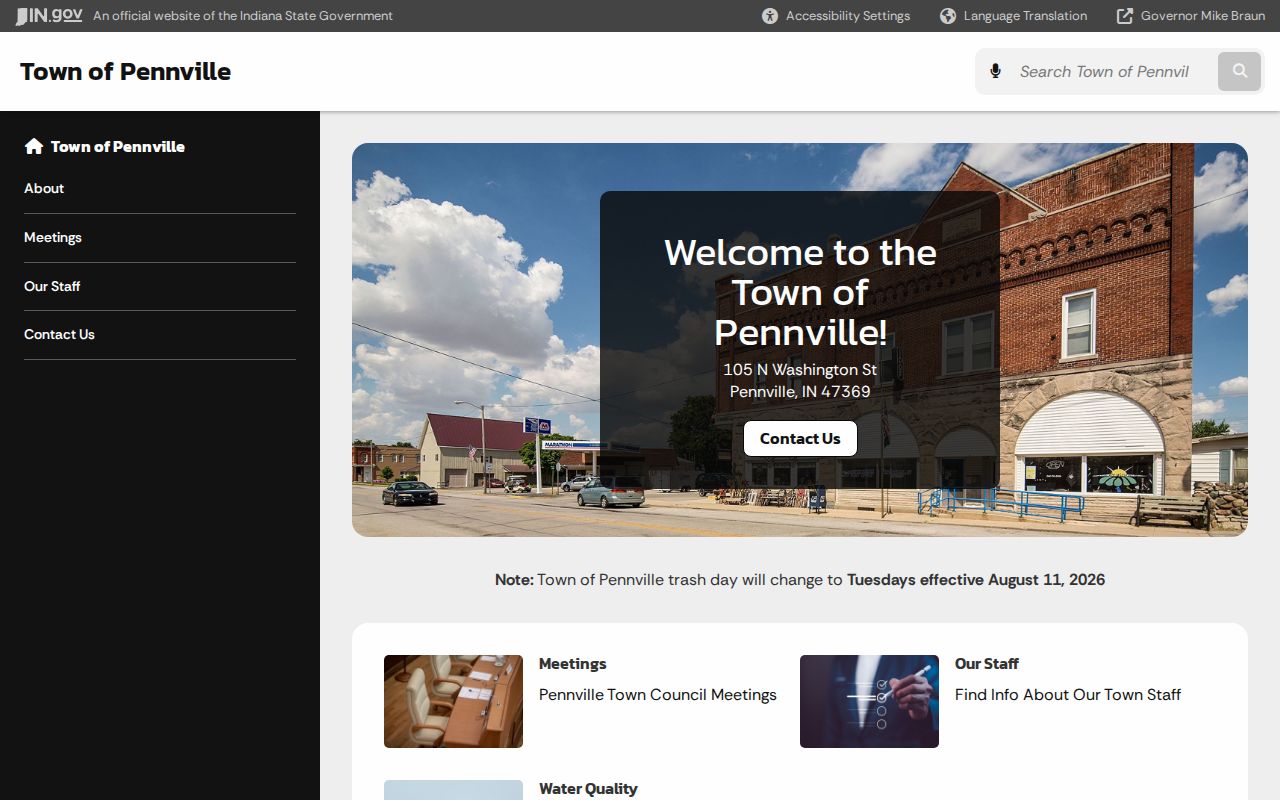
The image helps identify the right municipal source, but the town page does not turn that source into a court docket or warrant lookup.
Those details identify town government, not a warrant desk. The staff page names a clerk-treasurer and council but no police office, municipal court, or judicial clerk. Town hall can help with a town-service question, yet it should not be asked to certify a Jay court record. Use the named court or county office for that task.
The Pennville Police Department and Municipal Court
No Pennville police department page, municipal court page, warrant office, or public warrant portal was located on the official town home, contact, or staff pages. It would be wrong to invent a local agency, judge, clerk, or phone number. The verified route moves from the citation or notice to the court that issued it.
For county matters, the Jay Clerk maintains Circuit and Superior Court files. The sheriff is the verified enforcement contact. Portland City Court has its own traffic process, but Pennville residents should use it only when the document names Portland City Court. Place of residence and court jurisdiction are not the same fact.
A useful split is simple. The Jay Clerk's Office answers court-file and copy questions for Jay Circuit and Superior matters. The Jay County Sheriff's Office handles law-enforcement routing, while the court controls its warrant, hearing, bond, and recall orders. Pennville town staff should not be treated as a substitute for either office.
Pennville Clerk Is Not Court Clerk
Pennville's clerk-treasurer handles town government functions. The Clerk of the Jay Circuit and Superior Courts keeps judicial records for those county courts. Similar titles do not mean the offices share files. A general town contact form is also not a certified court-record request.
Town clerk-treasurer: A municipal officer listed by Pennville, with no documented warrant-record function.
Court clerk: The office that maintains the judicial case file and supplies public copies when allowed.
Sheriff: The county law-enforcement route for service, custody, and operational questions.
A focused court request should name the case or citation, document type, approximate date, parties, and certification need. That detail helps the correct clerk find the public record without turning a town inquiry into an open-ended search.
Types of Pennville Warrants
A Pennville resident may encounter several Indiana warrant types, but no verified Pennville court issues a separate local class of warrant. The issuing court and underlying case define the record. Indiana sources use arrest warrant, bench warrant, failure to appear, traffic warrant, recall, and search warrant terms.
| Warrant Type | How It Arises | Who Issues It |
|---|---|---|
| Traffic warrant | A failure to appear or answer a traffic summons | The court named on the citation |
| Bench or FTA warrant | A missed hearing or failure to follow release terms | Jay Circuit, Jay Superior, Portland City Court, or another named court |
| Arrest warrant | Criminal process supported by probable cause | An Indiana court or judge with jurisdiction |
| Search warrant | Authority to search or seize, not to publish an arrest list | A judge; access may be restricted |
Pennville's 2020 Warrant Context
The 2020 Census count for Pennville was 621, making it the fourth-largest incorporated place in Jay County. That figure explains why Pennville receives a city page, but it says nothing about warrants or crime. No Pennville warrant total, court caseload, local arrest count, or active list was found.
Small-town scale does not alter who owns a court record. A resident may still have a case in Jay Circuit, Jay Superior, Portland City Court, or a court outside the county. Search by the issuing authority, not by population or mailing address alone.
What a Pennville Warrant Record Shows
No Pennville-specific warrant schema was found. Indiana law and MyCase provide the safe field inventory. Read the court, case number, warrant event, and later orders together. An open case does not always mean an active warrant, while a recalled warrant can remain in historical docket entries.
| Case or Citation Number | MyCase accepts one case, citation, or cross-reference number, such as 38C01 or 38D01 case. |
|---|---|
| Person | The warrant identifies the person, while public display and redaction can vary. |
| Offense | Indiana arrest-warrant law calls for the nature of the alleged offense. |
| Issuing Court | The court that owns the case, not Pennville town hall by default. |
| Bail or Fine | Confirm any current amount with the court; no Pennville schedule was found. |
| Status | Verify active, served, recalled, or closed wording with the maintaining court. |
A Pennville Resident Using MyCase
MyCase offers Case, Name, and Attorney tabs. A case search accepts a case number, citation number, or cross-reference number. A name search can be narrowed by first name, middle name, date of birth, court, case status, and filing dates. The official tips warn that results are capped at 1,000, so broad names may need tighter fields.
Choose Jay Circuit Court code 38C01 or Jay Superior Court code 38D01 when the record likely belongs to a county court. Then read public events, hearings, orders, and documents for failure-to-appear, warrant, recall, release, or disposition language. MyCase is not a statewide warrant index and can omit restricted or offline material.
If a broad name search produces too many results, add the middle name, date of birth, court, status, or filing dates supported by the known case. Do not force a match based on name alone. A result marked open or closed describes the case, not necessarily the live status of a warrant. The next sound step is to give the case or citation number to the clerk and ask about the latest public order.
Where Pennville Warrants Fit With Jay County
Pennville has no verified local court or police portal, so the route begins with the issuing court. Jay Circuit and Superior records go through MyCase and the Jay Clerk; sheriff service or custody questions go to the Jay County Sheriff's Office. Indiana has no single public statewide criminal-warrant search.
Warrant flow: Issuing court › Jay Clerk or city-court file › Jay County Sheriff › MyCase public fallback
The Jay County warrant records overview explains the county system in full. For Pennville, the key is to avoid treating the town's address or contact form as proof of jurisdiction. Follow the court name on the record.
Pennville's Sheriff and Courthouse Sequence
If MyCase shows a Jay county case, call the Clerk of the Jay Circuit and Superior Courts at 260-726-4951. Ask whether the public file contains an active warrant, a later recall, a reset, or a disposition. For operational service or custody routing, call the sheriff rather than the Pennville clerk-treasurer.
The sheriff site has no public active-warrant list. Current inmate and recent booking tools are different datasets. A person may have a court warrant without appearing in either one. A written clerk request can obtain a docket or order, but it does not recall a warrant or substitute for the court's direction.
Public Access to Pennville Warrant Records
The Indiana Access to Public Records Act applies to public agency records, while court files are also governed by the Indiana Rules on Access to Court Records. Those rules presume access but preserve limits. A Pennville-related case may be sealed, juvenile, investigative, pretrial, or temporarily excluded during an arrest-warrant request.
Key Rules:
Indiana Access to Public Records Act, IC 5-14-3 gives access to public records subject to lawful exceptions.
Indiana Access Rule 5 protects specified sealed, private, investigative, pretrial, and temporary warrant-request records.
Indiana Code 31-39-1-2 places juvenile records under a separate confidentiality framework.
A no-result or denied copy is not proof of no warrant. Narrow the request, ask which rule applies, and verify permitted information with the court that maintains the file.
Pennville Contact Form Versus Records
Pennville's AccessGov contact form is a general way to reach town government. It does not promise a warrant search, court certification, or sheriff response. Do not send a broad request for every record or assume the form reaches the Jay Clerk.
For a court copy, give the document type, filing or order date, party names, case number, copy count, and certification choice. The Jay form lists $1 per page and $3 per certified document. A copy can prove what the court file says, but only the issuing court can direct recall, appearance, bond, or reset.
Pennville town hall remains useful when the question truly concerns a town record or service. When the question is whether judicial process exists, send it to the record custodian instead. If the issuing court cannot be identified, gather the citation, notice, prior hearing details, and any case number before calling. That short fact set helps the clerk or sheriff route the inquiry without implying that a general contact form reaches a court database.